
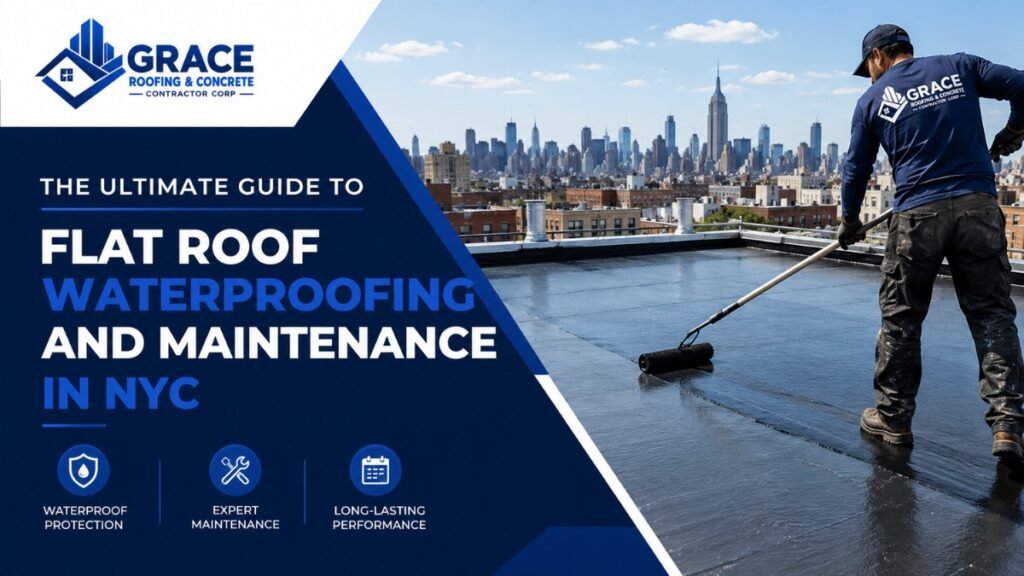
A flat roof in New York City takes a beating that few homeowners appreciate until water is already dripping through the ceiling. Freeze-thaw cycles in January, pounding rain in spring, brutal UV in July. The constant foot traffic of HVAC techs and satellite installers all conspire against a roof that has no slope to shed the abuse. Flat roof waterproofing is the single system standing between all of that and the wood, plaster, and belongings underneath.
This guide covers what actually keeps a low-slope roof watertight in the Bronx and across the five boroughs: how waterproofing systems work. Membranes hold up, the maintenance schedule that doubles a roof’s service life, and the warning signs that mean you call a contractor before a small repair becomes a structural one. After 16+ years waterproofing flat roofs across NYC, Grace Roofing & Concrete Contractor Corp has seen every failure mode this climate produces, and this is the playbook we use to prevent them.
Why Flat Roofs Fail (and Why NYC Is Harder Than Most)
A “flat” roof is never flat. It carries a slight pitch, usually between 1 and 10 degrees, so water drifts toward drains and scuppers. When that drainage is slow, blocked, or the surface has settled, water pools. Bonding water is the number-one enemy of any flat roof. Standing water finds every seam, pinhole, and aging spot, and freeze-thaw expansion pries those weaknesses wider each winter.
NYC adds specific stresses:
Thermal cycling – a black roof surface can swing 100°F+ between a summer afternoon and a winter night, expanding and contracting the membrane until seams fatigue.
UV degradation – unshaded rooftops bake, breaking down exposed membranes and coatings over time.
Foot traffic – mechanical equipment, service access, and shared roof decks in townhouses grind against the surface.
Aging building stock – many Bronx and Brooklyn buildings carry decades-old built-up or modified bitumen roofs long past their design life.
Waterproofing isn’t one product. It’s a system, substrate, insulation, membrane or coating, flashing at every edge and penetration, and a drainage path, that only works when every part is sound.
Flat Roof Waterproofing Systems Compared
There is no single “best” membrane, only the best fit for a given building, budget, and roof use. Here’s how the main options stack up.
| System | How It Works | Lifespan | Best For |
| EPDM (rubber) | Single-ply synthetic rubber, seams taped/glued | 20–30+ yrs | Low-traffic roofs, proven track record |
| TPO | Single-ply thermoplastic, heat-welded seams, reflective | 20–30 yrs | Energy savings, white reflective surface |
| Torch-down / Modified Bitumen | Asphalt membrane, multi-ply, flame-applied | 20–25 yrs | Puncture resistance, foot traffic |
| Liquid coatings (silicone/acrylic/PU) | Fluid-applied seamless membrane | 10–20 yrs | Restoration, complex details, no seams |
Each has a right and wrong application. Townhouse owners deciding between systems should read our detailed breakdown of EPDM, TPO. Torch-down roofing for townhouses, it walks through cost, install method, and foot-traffic tolerance for each. For roofs already installed and now baking in the sun, a reflective upgrade may pay for itself; see the case for installing a cool roof in New York City.
Liquid-applied systems deserve a note of their own. A smooth silicone or polyurethane coating over a sound existing roof restores waterproofing without a tear-off. Because there are no seams, there’s nowhere obvious for water to start. It’s not a fix for a failed roof, the substrate has to be sound first, but as a maintenance-driven restoration it’s one of the most cost-effective moves an owner can make.
The Non-Negotiable Steps of a Proper Waterproofing Job
When done right, waterproofing follows a sequence, and skipping steps is why so many roofs fail early:
Inspect the full roof, surface, seams, flashing, drains, and the deck beneath where accessible.
Clean the surface completely. Coatings and adhesives fail on dirty substrates. This step is skipped constantly and it’s the root of countless callbacks.
Repair cracks, blisters, open seams, and damaged flashing before anything goes over the top.
Prime where the system requires it.
Install the membrane or coating per manufacturer spec, thickness matters.
Seal seams, edges, and penetrations, pipes, vents, curbs, and especially wall transitions.
Cure fully. Applying in wet or cold conditions ruins adhesion.
Final inspection and a water test where feasible.
Two details cause more leaks than the field of the roof ever does: seams and flashing. Water almost never enters through the middle of an intact membrane. It enters where the membrane meets something else, a parapet wall, a drain, a vent pipe, a skylight curb. Parapet transitions in particular are a leak hot spot on NYC buildings; our guide to parapet wall maintenance, flashing. Code compliance covers that junction in depth.
The Flat Roof Maintenance Schedule That Doubles Lifespan
The difference between a roof that lasts 15 years and the same roof lasting 30 isn’t the membrane, it’s maintenance. Water intrusion is cumulative. Catch it early and it’s a caulk-gun repair; ignore it and it’s rotted decking and interior damage.
Twice a year (spring and fall), and after every major storm:
Clear all debris, leaves, branches, and grit that trap moisture and block drainage.
Clean drains, scuppers, and gutters so water actually leaves the roof.
Inspect seams and flashings for lifting, cracking, or open edges.
Check for ponding, any water still standing 48 hours after rain is a problem.
Look for blisters, splits, punctures, and bare spots in the coating.
Inspect parapet copings and wall transitions for cracked sealant.
Annually: a professional inspection that documents conditions and flags developing issues before they leak. Many building owners in NYC now pair this with mandated parapet observations.
The economics are simple. A maintenance visit and a few minor repairs cost a fraction of a leak that soaks insulation, feeds mold, and rots structural decking. Timely repair at the first sign of damage extends roof life more than any premium membrane.
Warning Signs You Have a Waterproofing Problem
Some leaks announce themselves; the dangerous ones don’t. By the time water reaches a ceiling, it has often traveled far from its entry point and already saturated hidden material. Watch for:
Water stains, yellow rings, or streaks on top-floor ceilings and walls
A musty smell, especially near the top floor or in a cock loft
Bubbling paint or warped flooring in upper rooms
Standing water on the roof after 48 hours
Blisters, cracks, or lifting seams on the membrane
Granules or coating washing into gutters
Because hidden leaks do the most structural damage, knowing how to catch them early is its own skill. We cover the professional detection methods in how to detect and stop hidden roof leaks before structural damage.
Frequently Asked Questions
How long does flat roof waterproofing last?
It depends on the system and maintenance. Single-ply membranes like EPDM and TPO typically last 20–30 years, torch-down modified bitumen 20–25 years, and liquid coatings 10–20 years. Regular maintenance can push any of these toward the top of its range; neglect cuts it short.
Can you waterproof a flat roof in winter?
Most coatings and adhesives need dry conditions and temperatures above a manufacturer-specified minimum to cure properly. NYC winters often make this impractical. Emergency repairs can be done cold, but full waterproofing is best scheduled for milder, dry weather.
How much does flat roof waterproofing cost in NYC?
Cost varies with roof size, chosen system, existing condition, access, and how much repair the substrate needs before waterproofing. A restoration coating over a sound roof costs far less than a full tear-off and re-roof. The only accurate figure comes from an on-site inspection.
Is ponding water always a problem?
Yes. Water standing more than 48 hours after rain accelerates membrane breakdown, adds structural load, and finds every weak seam. It signals a drainage or slope issue that should be corrected, not ignored.
Do I need to tear off my old roof to waterproof it?
Not always. If the existing roof and decking are structurally sound and dry, a liquid-applied coating or an overlay can restore waterproofing without a full tear-off, saving significant cost. A moisture survey determines whether the substrate qualifies.
The Bottom Line
A watertight flat roof is a system, not a product, and it stays watertight through maintenance, not luck. Choose the right membrane for how your roof is actually used, insist on proper seam and flashing work, and inspect twice a year plus after storms. Do that, and a flat roof reliably outlasts its warranty.
If your roof is showing any of the warning signs above, or you haven’t had it inspected in over a year, Grace Roofing & Concrete Contractor Corp has waterproofed and maintained flat roofs across the Bronx and NYC for over 16 years. Explore our flat roofing and roofing services or call +1 (646) 688-8222 to schedule an inspection.