
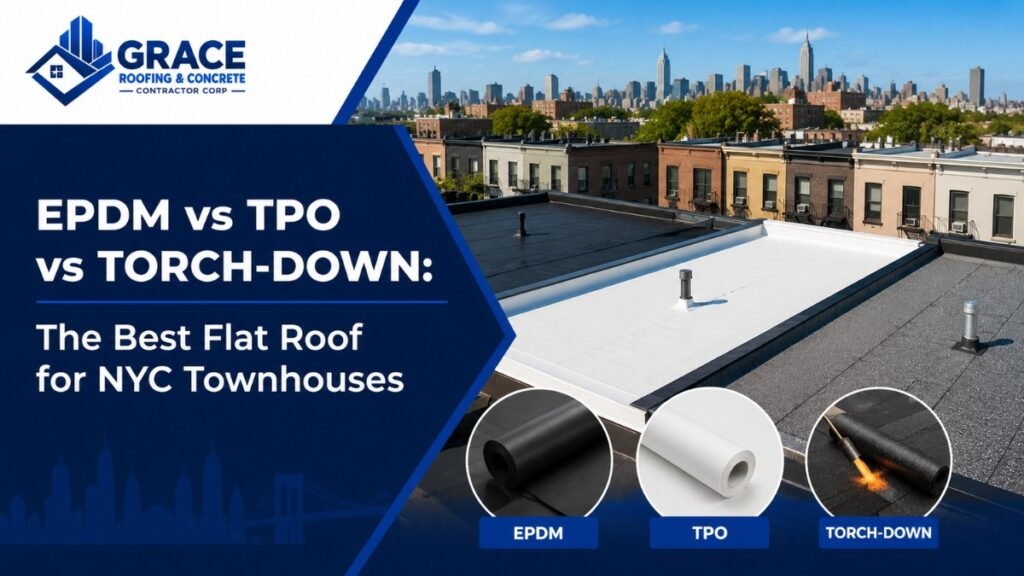
Choosing a flat roof for a townhouse feels like being handed a menu in a language you don’t speak. A contractor says “EPDM,” another pushes “TPO,” a third swears by “torch-down,” and each is certain the others are wrong. They’re all partly right, each system is genuinely the best choice for “some” townhouses and the wrong choice for others.
The trick is matching the membrane to how your specific roof gets used. This comparison breaks down the three systems that dominate NYC townhouse roofs: what they’re made of, how long they last, what they cost to install, and, the part most guides skip, how they handle the foot traffic and tight rooftop layouts that define row-house living. It fits inside our broader ultimate guide to flat roof waterproofing; this article is the deep dive on picking the membrane itself.
The Three Contenders at a Glance
| Factor | EPDM (Rubber) | TPO | Torch-Down (Mod Bitumen) |
| Material | Synthetic rubber, single-ply | Thermoplastic, single-ply | Asphalt + rubber/plastic polymers, multi-ply |
| Typical color | Black (white available) | White/reflective | Black/gray (granular) |
| Seams | Adhesive or tape | Heat-welded | Flame-welded plies |
| Lifespan | 20–30+ years | 20–30 years | 20–25 years |
| Foot traffic | Very good | Moderate | Excellent |
| Puncture resistance | Moderate | Moderate | Excellent |
| Reflectivity | Low (black) | High | Low |
| Install method | Cold-applied, low skill | Hot-air weld, skilled | Open flame, skilled + fire risk |
EPDM: The Proven Workhorse
EPDM (ethylene propylene diene monomer) is synthetic rubber and the original single-ply membrane, dating to the 1960s. Its biggest selling point is track record, no other modern flat-roof system has as long a real-world history. Well-maintained EPDM roofs regularly pass 30 years.
Strengths: Cold-applied with simple tools, so installs are fast and labor is lower. It handles foot traffic well, a real advantage on townhouses where the roof doubles as access or a small deck. It’s flexible in the cold, which suits NYC winters, and repairs are straightforward.
Weaknesses: Standard EPDM is black, so it absorbs heat and offers no energy benefit, the opposite of what a hot top-floor bedroom needs. Its seams are adhered rather than welded, so seam maintenance matters more over time. A white EPDM exists but costs more and is less common.
Best townhouse fit: Owners who want proven longevity, plan on roof foot traffic, and aren’t prioritizing summer cooling.
TPO: The Reflective Energy Saver
TPO (thermoplastic polyolefin) is a single-ply membrane with heat-welded seams and, crucially, a white reflective surface. That reflectivity is its headline feature: it bounces solar heat instead of absorbing it, which cuts cooling load on the floor below.
Strengths: The welded seams create a monolithic, strong bond, arguably TPO’s best structural trait. The reflective surface is a genuine energy advantage in NYC summers and aligns with the city’s push toward cool roofs. Clean, modern appearance.
Weaknesses: TPO is more sensitive to UV-driven wear over the long haul, with real-world life often landing in the low-to-mid 20s before the top layer shows serious wear. It tolerates heavy foot traffic and rooftop mechanical wear less gracefully than EPDM or torch-down. Installation requires a skilled hand and welding equipment.
Best townhouse fit: Owners focused on lowering summer cooling bills and comfortable top floors. If energy savings are the priority, weigh TPO against a dedicated reflective coating in our guide to the benefits of a cool roof in NYC.
Torch-Down (Modified Bitumen): The Toughest Surface
Torch-down is asphalt-based modified bitumen, applied in multiple plies with an open flame that melts the layers into a bonded system. Layer a granular cap sheet over a base ply and you get a two-ply system that’s about as rugged as flat roofing gets.
Strengths: Outstanding puncture and foot-traffic resistance, the granular surface shrugs off dropped tools, ladder feet, and service traffic that would scuff a single-ply. Excellent UV protection. Multi-ply redundancy means one damaged spot doesn’t mean instant leak.
Weaknesses: The open-flame install is a real fire hazard, especially on attached townhouses where cocklofts and shared walls raise the stakes, many owners and some insurers are wary of torching over occupied row houses. It’s black, so no energy benefit, and skilled installation is essential.
Best townhouse fit: Roofs that see heavy traffic or abuse. Owners who prioritize toughness and redundancy over energy savings, provided a qualified crew manages the fire safety.
The Townhouse-Specific Factors Most Guides Ignore
Townhouses change the math in ways a standalone-building comparison misses:
Shared walls and cocklofts make torch-down’s open flame a more serious consideration than on a detached structure. Fire spread between attached units is a genuine risk.
Parapet walls are near-universal on NYC row houses, and every membrane has to terminate cleanly against them. The membrane choice matters less here than the flashing detail, see parapet wall maintenance, repairs, and flashing for why that junction leaks first.
Roof as living space, many townhouse owners use the roof for access, storage, or a deck. That foot traffic pushes the decision toward EPDM or torch-down over TPO.
Tight access for materials and equipment can favor cold-applied EPDM over systems needing bulky welding or torching gear hauled up narrow stairs.
Which Should You Choose?
Choose EPDM for proven longevity, foot traffic, and simpler repairs.
Choose TPO to cut summer cooling costs with a reflective surface.
Choose torch-down for maximum toughness where the roof takes abuse, with a crew that manages fire safety on attached buildings.
No membrane succeeds without correct installation and maintenance. A cheaply installed premium system leaks before a well-installed budget one. Whatever you pick, seams, flashings, and a maintenance schedule decide its real lifespan, the fundamentals covered in our flat roof waterproofing and maintenance guide.
Frequently Asked Questions
Which lasts longest, EPDM, TPO, or torch-down?
Well-maintained EPDM has the longest proven track record, often 30+ years. TPO typically reaches the mid-20s to 30, and torch-down 20–25. Maintenance and install quality affect real lifespan more than the material category.
Is torch-down roofing safe on an attached townhouse?
It can be, but the open flame raises fire risk on buildings with shared walls and cocklofts. It requires an experienced crew with proper fire-watch procedures. Many townhouse owners choose a single-ply system specifically to avoid the flame.
Which flat roof is best for lowering my cooling bills?
TPO, thanks to its reflective white surface, or a dedicated reflective cool-roof coating. Black EPDM and torch-down absorb heat and offer no cooling benefit. In NYC’s summers, reflectivity noticeably reduces top-floor heat and AC load.
Can I install a new membrane over my existing flat roof?
Sometimes. If the existing roof and decking are sound and dry, an overlay may be possible and saves the cost of a tear-off. A wet or failing substrate must be removed first. A moisture inspection determines which applies.
Which is cheapest to install?
EPDM is usually the most economical to install because it’s cold-applied with simple tools and less labor. TPO and torch-down need skilled crews and specialized equipment, raising install cost, though total value depends on lifespan and energy savings, not just upfront price.
The Bottom Line
There’s no universal winner, only the right membrane for your townhouse’s traffic, energy goals, and fire considerations. EPDM for proven durability, TPO for energy savings, torch-down for brute toughness. Get the install and the flashing details right, and any of the three will protect your home for decades.
Not sure which fits your building? Grace Roofing & Concrete Contractor Corp has installed all three across NYC townhouses for 16+ years and can assess your roof in person. Call +1 (646) 688-8222 to talk it through.