
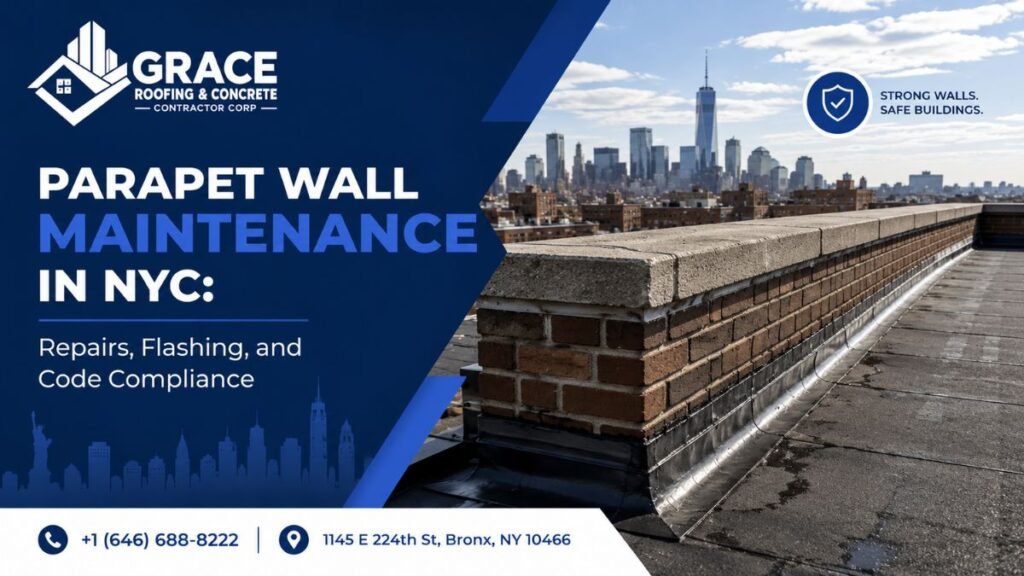
The low wall running around the edge of a flat roof does two demanding jobs at once: it keeps people from walking off the roof. It’s the most exposed, weather-beaten masonry on the entire building. That combination makes the parapet both a safety-critical structure and the single most common place a flat roof starts to leak. And since January 1, 2024, NYC law requires most building owners to have their parapets inspected every year, which means parapet maintenance is no longer optional.
This guide covers what a parapet wall needs to stay sound: how flashing protects it, the deterioration to watch for, what repairs involve. Exactly what NYC’s annual parapet inspection law requires of owners. It’s part of our flat roof waterproofing and maintenance guide, and it’s the deep dive on the wall junction where more roofs leak than anywhere else.
Why the Parapet Is Your Roof’s Weak Point
A parapet is exposed on multiple faces, top, roof side, and street side, so it weathers faster than any other part of the building. Water attacks it from every direction: rain on the coping, wind-driven moisture into the joints. Roof water at the base where the wall meets the membrane. Freeze-thaw then pries every crack wider each winter.
Critically, the parapet is where the roof membrane *terminates*. The waterproofing has to turn up the wall and be sealed, and that transition, protected by flashing, is where failure concentrates. When the flashing goes, water gets in behind the wall, travels down into the building. Often shows up as a “roof leak” whose true source is the parapet. This is why parapet failure is a leading cause of the hidden leaks that damage structure before anyone spots them.
Flashing: The Detail That Keeps Water Out
Flashing is the metal or membrane barrier that seals the joint between the parapet and the roof and prevents water from getting behind the wall. It’s the parapet’s raincoat, and when it fails, the wall has no defense.
Common flashing failures:
Failed through-wall flashing, missing or compromised flashing embedded in the wall lets water pass straight through.
Rust and corrosion, metal flashing deteriorates, separates from the wall, and opens gaps.
Cracked or dried sealant, at the coping, expansion joints, and penetrations, old sealant shrinks and cracks, breaking the seal.
Separation from the wall, flashing pulling away creates an open channel straight into the masonry.
Flashing replacement is skilled work, it typically runs on the order of $85–$120 per linear foot, but it’s far cheaper than the structural masonry repair that follows years of water getting behind an unflashed wall.
Common Parapet Deficiencies to Watch For
During a roof check, inspect the parapet for:
Cracked, spalling, or bulging masonry, signs the wall is taking on water and freeze-thaw damage.
Deteriorated mortar joints, crumbling or missing mortar lets water in and weakens the wall.
Loose, cracked, or missing coping, the cap on top of the wall is the first line of defense; a gap there funnels water into the core.
Failed sealant at coping joints, expansion joints, and penetrations.
Leaning or displacement, any lean is a safety red flag requiring immediate professional attention.
A leaning or bulging parapet isn’t just a leak risk, it’s a falling-masonry hazard over the sidewalk. Is exactly what the city’s inspection law targets.
Parapet Repairs: What They Involve
Repairs scale with the damage:
Repointing, for deteriorated mortar joints, the old mortar is cut out to a minimum depth of twice the joint width. New mortar matching the original in composition, color, and profile is packed in. Done right, this restores both weather resistance and strength.
Sealant replacement, old sealant at coping and joints is removed and replaced to reseal the wall.
Flashing replacement, failed flashing is stripped and rebuilt, re-establishing the water barrier at the roof junction.
Coping repair or replacement, cracked or loose caps are reset or replaced to shed water off the top.
Rebuilding, a severely deteriorated or leaning section may need partial reconstruction.
On the permit question: minor repairs like repointing and sealant replacement typically don’t require a DOB permit. Major work involving structural modification, reconstruction, or changes to the building exterior does require DOB filing and may need a permit. A qualified contractor confirms which category your job falls in before starting.
NYC’s Annual Parapet Inspection Law (What Owners Must Know)
This is the part every NYC building owner needs to understand.
The requirement: Since January 1, 2024, every building owner must have their parapet observed annually.
Who it applies to: All buildings with parapets fronting the public right-of-way, regardless of height.
Who’s exempt: Detached 1- and 2-family homes, and buildings with barriers that prevent public access to the exterior wall.
If a problem is found: The person performing the observation must immediately notify the Department of Buildings. The owner must immediately install public protection, a sidewalk shed or safety netting, to protect pedestrians.
The deadline to fix: All unsafe conditions must be corrected within 90 days of notification to the Department.
Ignoring the requirement risks violations, fines, and, far worse, liability if failing masonry injures someone below. Pairing the mandated observation with the maintenance in our flat roof waterproofing and maintenance guide keeps you both compliant and leak-free.
Frequently Asked Questions
Are parapet inspections required in NYC?
Yes. Since January 1, 2024, owners of buildings with parapets fronting the public right-of-way must have them observed annually, regardless of building height. Detached 1- and 2-family homes and buildings with public-access barriers are exempt.
How often should a parapet wall be maintained?
Beyond the required annual observation, inspect the parapet during your twice-yearly roof maintenance and after major storms. Catching cracked sealant or failing flashing early prevents both leaks and the larger masonry repairs that follow neglect.
What does parapet flashing do, and why does it fail?
Flashing seals the joint between the parapet and the roof so water can’t get behind the wall. It fails from rust and corrosion, cracked or dried sealant. Separation from the wall, all of which open paths for moisture into the masonry and the building below.
Do parapet repairs need a permit in NYC?
Minor repairs like repointing and sealant replacement typically don’t require a permit. Major work, structural modification, reconstruction, or exterior changes, requires DOB filing and may need a permit. A qualified contractor determines which applies before work begins.
What happens if my parapet fails inspection?
The inspector must immediately notify the Department of Buildings, and you must immediately install public protection like a sidewalk shed or netting. You then have 90 days from notification to correct all unsafe conditions. Acting quickly limits both liability and cost.
The Bottom Line
The parapet is the hardest-working, most-exposed part of your building, a safety structure and your roof’s most common leak point in one. Sound flashing, intact mortar and coping, and fresh sealant keep it watertight; regular maintenance keeps it safe. And in NYC, the annual inspection is now the law, with a 90-day clock on any unsafe condition. Stay ahead of it and you avoid violations, leaks, and liability all at once.
Need a parapet inspection, flashing repair, or help meeting the NYC annual requirement? Grace Roofing & Concrete Contractor Corp has maintained and repaired NYC parapets and flat roofs for 16+ years. Call +1 (646) 688-8222 to schedule.