
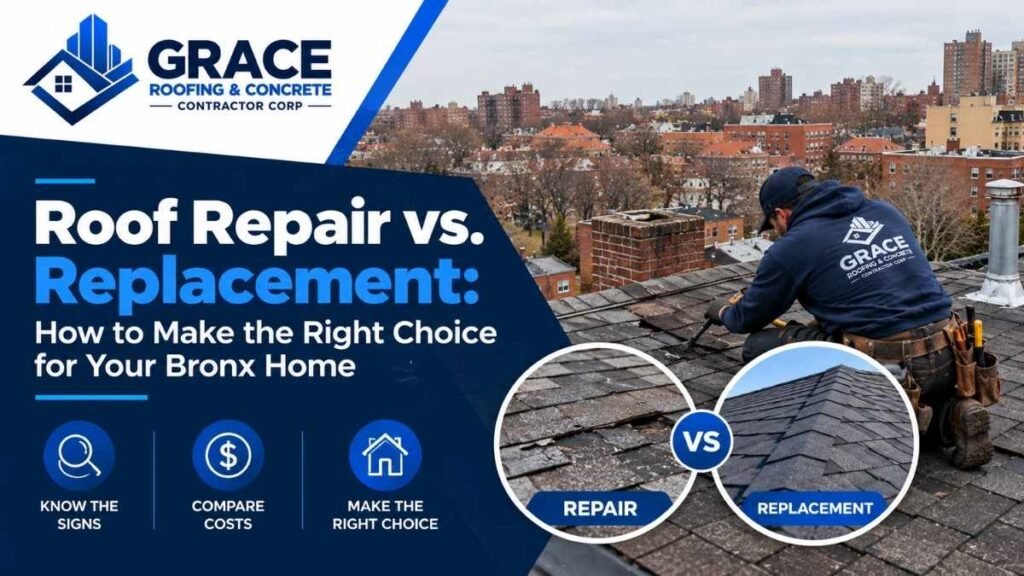
A leak shows up, you call a roofer, and you get one of two answers: “We can patch that for a few hundred dollars” or “You need a whole new roof.” Both could be honest, and either could be a sales pitch. Choose wrong and you’ll either keep paying for patches on a roof that’s worn out, or replace a roof that has years of life left.
This guide explains how experienced roofers decide between roof repair vs. replacement, so you can judge any recommendation yourself. We cover the six factors that matter, the cost thresholds that change the answer, what’s different about Bronx flat roofs, and the questions that reveal whether a contractor is being straight with you. For the bigger picture on roof types, materials and hiring, see our residential roofing guide for Bronx homeowners.
The Short Answer
Repair when the roof is in the first half to two-thirds of its expected life, the damage is limited to one area, the decking underneath is dry and solid, and this is the first time that spot has failed.
Replace when the roof is near or past its expected life, problems are showing up in several places, the same area keeps leaking after repairs, the decking is soft or rotted, or repair costs are adding up to a large share of what a new roof would cost.
Most real situations fall between these two. The six factors below will help you decide.
Factor 1: How Old Is Your Roof?
Age is the first thing to check. Compare your roof’s age with the typical lifespan of its material:
| Material | Typical lifespan | “Repair zone” | “Replacement zone” |
| 3-tab asphalt shingles | 15–20 yrs | Under 12 yrs | 15+ yrs |
| Architectural shingles | 25–30 yrs | Under 18 yrs | 22+ yrs |
| Modified bitumen (flat) | 15–25 yrs | Under 12 yrs | 18+ yrs |
| EPDM / TPO (flat) | 20–30 yrs | Under 15 yrs | 20+ yrs |
| Metal | 40–70 yrs | Most of its life | 40+ yrs with widespread issues |
| Slate / tile | 50–100+ yrs | Almost always repair | Only if underlayment or fasteners fail widely |
Don’t know your roof’s age? Check your purchase inspection report, look up DOB permit history for your address on the NYC Department of Buildings website, or ask a roofer to estimate it from shingle wear and granule loss.
A note on slate and tile: On long-life materials, “replace the roof” usually means the fasteners or underlayment have failed, not the slate itself. A skilled roofer can often remove the slate, replace the underlayment and reinstall much of the original slate. Get a second opinion before you tear off a slate roof.
Factor 2: How Much of the Roof Is Damaged?
• Localized damage includes a few missing shingles after a storm, one cracked flashing boot, or a single blister on a flat roof. These are repair jobs.
• Widespread damage includes curling across whole slopes, granule loss everywhere, seams opening along the length of a membrane, or storm damage across several sections. These point toward replacement.
A useful rule: if more than about 25–30% of a roof surface needs work, a full replacement usually costs less over time and looks better. It also avoids a patchwork of mismatched materials.
Factor 3: Are the Leaks New or Recurring?
This factor matters most, and homeowners often misread it.
A single leak in a roof that’s otherwise healthy is usually a flashing or penetration issue, and a repair will fix it.
A leak that keeps coming back after being “fixed” means one of three things:
1. The repair didn’t address the real entry point. Water often travels along rafters or inside parapet walls before it shows up.
2. The surrounding material is too worn to hold a repair.
3. The problem is bigger than one spot, such as failed underlayment or bad drainage.
If the same area has been repaired twice and still leaks, stop patching. Get an inspection that finds the actual entry point, and seriously consider replacement.
Factor 4: What’s Happening Under the Surface?
The decking and structure matter more than the shingles or membrane you can see.
Signs of decking damage:
• Soft or spongy spots when walking the roof
• Visible sagging between rafters
• Water-stained or dark, delaminating plywood seen from the attic
• Wet or compressed insulation
• Mold or a musty smell in the attic or top-floor closets
If the decking is wet across a large area, a surface repair won’t last. The new material will be sitting on rotting wood. That usually means replacement, with the rotted decking replaced as part of the job.
Factor 5: The Cost Math
Typical national ranges, per published guides:
• Roof repairs: roughly $300–$3,500, depending on scope
• Full replacement: roughly $10,000–$25,000+ for an average home, with NYC projects typically 20–25% higher
Two rules of thumb roofers use
The 30% rule. If a single repair costs about 30% or more of a full replacement, replacement is usually the better value, especially on a roof past its midpoint.
The cumulative rule. Add up what you’ve spent on repairs in the last three to five years. Once that total approaches half the cost of a new roof, you’re paying for a new roof in installments without getting one.
A Bronx example
Take a Soundview rowhouse with a 17-year-old modified bitumen roof. The owner spent $900 two winters ago on parapet flashing and $1,400 last fall on a drain area, and now has a new leak near the bulkhead with a $1,200 quote. That’s $3,500 in repairs on a roof near the end of its life, where a replacement might run $12,000–$16,000. The next repair won’t be the last. In this situation, replacing the roof, with new parapet flashing and a properly sloped drain area, is usually the better financial choice.
For a full breakdown of what drives replacement pricing, see our new roof cost guide by size and material.
Factor 6: Your Plans for the House
• Selling within 1–3 years? Repair small problems, but know that buyers’ inspectors will flag an old roof. A new roof can remove a negotiating point and help the sale.
• Staying 10+ years? Replacing now, before damage spreads to the interior, usually costs less over time.
• Renting out units? Recurring leaks in tenant apartments bring repair calls, damage claims and possible HPD complaints. Reliability is worth more to you than to an owner-occupant.
• Planning solar? Replace an aging roof before installing panels. Removing and reinstalling panels later adds significant cost.
Special Considerations for Bronx Flat Roofs
Low-slope roofs on attached homes make the decision more complicated:
• Ponding water. If water sits more than 48 hours after rain, the roof has a slope or drainage problem. Patching the membrane won’t fix it. The long-term fix is replacement with tapered insulation or re-pitched drains.
• Parapet and coping failure. Many “roof leaks” are actually masonry leaks. Replacing the roof without fixing cracked coping or deteriorated parapet brick won’t stop them. A contractor who does both roofing and masonry, as we do, can find the real source.
• Multiple layers. NYC generally limits roofs to two layers. If you already have two, any replacement means a full tear-off, which affects cost and timing.
• Neighbor tie-ins. On a continuous rowhouse roof, your section may be in good condition while the neighbor’s is failing. Sometimes the right fix is a careful repair at the joint between the two roofs rather than a full replacement.
What About Partial Roof Replacement or Re-Roofing?
Partial replacement means replacing one slope or section. It can make sense when damage is limited to one side, such as a storm-damaged slope on a young roof. The downsides are color mismatches and a seam where old and new materials meet.
Re-roofing (overlay) means installing new shingles over one existing layer. It costs less upfront but hides decking problems, adds weight, and may shorten the new roof’s life or affect warranty coverage. In NYC, it’s not an option if two layers are already there.
For most Bronx homes past their midpoint, a full tear-off and replacement gives the most reliable result.
Storm Damage and Insurance
After a nor’easter or windstorm:
1. Photograph everything right away, including damage outside and water stains inside.
2. Make temporary repairs such as tarping to prevent further damage. Keep the receipts.
3. Get a professional inspection before you call the adjuster, so you know what’s actually damaged.
4. Check your policy for roof-age depreciation. Many insurers pay only depreciated value on older roofs.
Insurance typically covers sudden damage, not age-related wear. If your roof was already near the end of its life, a claim may cover only part of a replacement.
Questions That Show Whether a Contractor Is Honest
Ask these before accepting any repair-or-replace recommendation:
1. “Can you show me photos of the damage and where the water is getting in?”
2. “How much life do you estimate is left if I only repair?”
3. “What did you find when you checked the decking and attic?”
4. “If I repair now, what should I budget for over the next three years?”
5. “Why isn’t there enough repair here?” or “Why isn’t replacement necessary?”
A trustworthy roofer answers with evidence, not pressure. If one contractor says “replace” and another says “repair,” ask each to explain the other’s view. That usually shows who’s right.
Once you decide to replace, choosing a material is the next step. If you’re repairing for now, a regular roof inspection and maintenance routine is the best way to make that repair last.
Frequently Asked Questions
How do I know if my roof needs repair or replacement?
Look at four things: the roof’s age compared with its expected lifespan, how widespread the damage is, whether leaks keep coming back, and the condition of the decking. A young roof with one localized problem needs a repair. An aging roof with problems in several places or soft decking usually needs replacement.
How many times can a roof be repaired?
There’s no fixed limit. If the same area has failed more than twice, or repair costs over the last few years are approaching half the cost of a new roof, replacement usually makes more financial sense.
Is it cheaper to repair or replace a roof?
A repair always costs less upfront. Over time, repeated repairs on an aging roof, plus the interior damage from recurring leaks, often cost more than a replacement would have.
Can I replace just part of my roof?
Yes, when damage is limited to one section of a relatively young roof. Expect some color difference between old and new materials, and make sure the contractor seals the joint between them carefully.
Does a leak always mean I need a new roof?
No. Most first-time leaks come from flashing, pipe boots, chimneys or parapet coping, and all of these can be repaired. A leak points to replacement only when it comes with age, widespread wear or repeated failure.
Will insurance pay for a roof replacement?
Insurance often pays for damage from sudden events like windstorms or falling trees, sometimes minus depreciation for older roofs. It generally won’t pay for wear from age or neglect.
How long does a roof repair last?
A quality repair on a healthy roof can last as long as the rest of the roof. A repair on a roof past its lifespan may only hold for one or two seasons.
The Bottom Line
The decision between roof repair and replacement comes down to evidence: the roof’s age, how widespread the damage is, whether leaks recur, the condition of the decking and the cost comparison. Repair a healthy roof with a single problem. Replace a worn roof that’s failing in several places. Whichever you’re told, ask the contractor to show you the evidence and explain the numbers before you pay.