
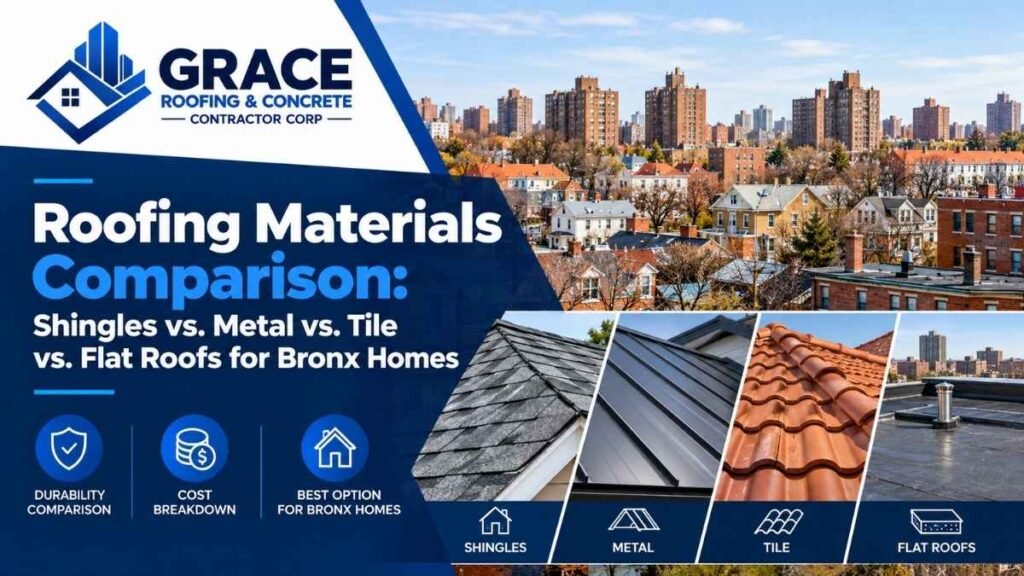
Pick the wrong roofing material and you’ll know within a few winters. You might see shingles cracking in the cold, a membrane pulling away from a parapet, or tile that’s too heavy for a 100-year-old frame house. Pick the right one and you may not think about your roof for decades.
This roofing materials comparison covers the four main categories Bronx homeowners choose from: asphalt shingles, metal, tile (including slate) and flat-roof membranes. We compare cost, lifespan, weight, wind and fire performance, energy efficiency and how each one holds up through NYC’s freeze-thaw cycles. If you’re newer to roofing in general, start with our complete homeowner’s guide to residential roofing, then come back here to narrow down your choice.
One thing first: your roof’s slope decides most of this for you. Shingles, metal panels and tile need a pitched roof. Most attached Bronx rowhouses have low-slope roofs, which need a membrane system. The real choice is usually among the options that suit your roof shape.
Quick Comparison Table
| Factor | Asphalt shingles | Standing-seam metal | Clay/concrete tile & slate | Flat membranes (mod-bit, EPDM, TPO) |
| Roof type | Pitched (4/12 and up is ideal) | Pitched, some low-slope | Pitched, strong structure | Low-slope / flat |
| Lifespan | 15–30 yrs | 40–70 yrs | 50–100+ yrs | 15–30 yrs |
| Installed cost (national, USD per sq ft) | ~4.50–8.50 | ~14–22 | ~10–25+ (slate higher) | ~5.50–10 |
| Weight | Light | Very light | Heavy to very heavy | Light |
| Wind resistance | Good (many rated 110–130 mph) | Excellent | Good if properly fastened | Good when fully adhered |
| Fire rating | Class A (most) | Class A | Class A | Varies by system |
| Maintenance | Low–moderate | Low | Low, but repairs are specialized | Moderate: drains and seams |
| Cold-climate notes | Needs ice & water shield | Snow slides off; needs snow guards | Freeze-thaw can crack lower-grade tile | Seams and flashing are the weak points |
Cost ranges are drawn from RoofVista’s 2026 materials guide and This Old House cost data. New York City projects typically run 20–25% higher than state averages because of labor, access and permit costs.
Asphalt Shingles: The Default for Pitched Roofs
Asphalt shingles cover most pitched-roof homes in the U.S., and the same is true in the Bronx. They’re affordable, quick to install, come in many colors and are easy to repair.
3-tab vs. architectural vs. designer shingles
• 3-tab shingles are flat and uniform, the lowest-cost option, with a lifespan of about 15–20 years. They’re increasingly hard to find, and many contractors no longer recommend them.
• Architectural (dimensional) shingles are thicker, layered and more wind-resistant, lasting about 25–30 years. They’re the standard choice today.
• Designer/luxury shingles are heavier and made to look like slate or cedar shake, typically lasting 30+ years.
Pros
• Lowest upfront cost for a pitched roof
• Widely available; nearly every roofer installs them
• Individual shingles can be replaced after storm damage
Cons
• Shortest lifespan of the pitched options
• Granules wear off over time, especially on south-facing slopes
• Prone to ice dams without proper ventilation and ice & water shield
Best for: Detached and semi-detached Bronx homes where the owner wants a reliable roof at a reasonable price and doesn’t plan to stay 40+ years.
Metal Roofing: Long Life, Higher Upfront Cost
Metal roofing includes two main styles:
• Standing-seam panels have raised seams and concealed fasteners. They’re the premium option and the most leak-resistant.
• Exposed-fastener panels cost less, but the rubber washers on the screws break down and need attention every 10–15 years.
Material choice matters too. Galvalume steel, a zinc-aluminum coated steel, is the most common. Aluminum resists corrosion better, which helps near the water in City Island or Throggs Neck. Copper and zinc are premium choices usually saved for accents or historic work.
Pros
• Lasts 40–70 years, often longer than you’ll own the house
• Sheds snow, which reduces ice-dam risk
• Reflective finishes reduce summer heat gain
• Recyclable at end of life
Cons
• Costs two to three times as much as architectural shingles upfront
• Snow can slide off suddenly; snow guards are important above entrances and walkways
• Dents from large hail or falling branches
• Rain noise if installed without solid decking and underlayment (rarely an issue when installed properly)
A cost-per-year view: RoofVista’s analysis puts architectural shingles and standing-seam metal at a similar cost per year of service life. Metal costs more upfront but lasts about twice as long. If you plan to stay in the house 25+ years, metal often costs the same or less over time.
Best for: Long-term owners of pitched-roof homes, homes with heavy tree cover and snow build-up, and owners who want to avoid another roof replacement.
Tile and Slate: Beautiful, Durable and Heavy
Clay tile
Clay tile can last 50–100+ years, holds its color and gives a distinctive Mediterranean look. It’s rare in the Bronx and costly to install.
Concrete tile
Concrete tile costs less than clay and lasts roughly 30–50 years, but it’s heavy and absorbs more water. In freezing climates, water absorption matters: water gets into the tile, freezes, expands and can crack it.
Natural slate
Slate is found on some historic homes in Riverdale, Fieldston and older parts of the borough. A good slate roof can last a century. Repairs require a slate specialist, and replacing slate with asphalt removes much of an older home’s character and value.
Synthetic slate and tile
Synthetic slate and tile are polymer or rubber composites that look like the real thing at a fraction of the weight. They’re a practical option when a home’s structure can’t carry natural stone.
Pros
• Longest lifespan of any residential roofing
• Class A fire resistance
• High curb appeal and historic character
Cons
• Weight. Clay and concrete tile can weigh several times as much as asphalt, and slate even more. Older Bronx frame homes may need an engineer’s review and structural reinforcement.
• Highest upfront cost
• Tiles can crack if walked on, which makes gutter and chimney work harder
• Fewer contractors are qualified to install and repair them
Best for: Historic homes that already have slate or tile (repair and preserve them rather than replace), and high-end homes with the structure to support the weight.
Flat Roof Materials: What Most Bronx Rowhouses Use
This section matters most for Bronx homeowners, even though national comparison guides tend to rush through it. Attached and multi-family homes across the South and Central Bronx almost all have low-slope roofs. The main options:
Modified bitumen (mod-bit)
Modified bitumen is asphalt reinforced with polyester or fiberglass. It comes in rolls that are heat-welded (torch-applied) or cold-applied/self-adhered.
• Lifespan: about 15–25 years
• Strengths: Tough, handles foot traffic, familiar to most NYC roofers, easy to repair
• Watch-outs: Torch-applied systems carry fire risk and require trained, insured crews. Dark cap sheets need a reflective coating to meet NYC cool-roof rules.
EPDM (rubber)
EPDM is a synthetic rubber membrane, usually black, installed in large sheets.
• Lifespan: about 20–30 years
• Strengths: Stays flexible in cold weather, few seams, lower cost
• Watch-outs: Seams are glued or taped, and poor seam work causes failures. Black EPDM absorbs heat unless you choose white EPDM or add a coating.
TPO (thermoplastic polyolefin)
TPO is a white, heat-reflective single-ply membrane with heat-welded seams.
• Lifespan: about 20–30 years
• Strengths: Reflective surface helps with NYC cool-roof requirements and keeps top floors cooler. Welded seams are strong.
• Watch-outs: Product quality varies by manufacturer. Detailing around parapets and penetrations requires skill.
PVC and built-up roofing (BUR)
PVC is a premium single-ply membrane with excellent chemical and fire resistance, more common on commercial buildings. BUR, the traditional tar-and-gravel system, is heavy and less common on new residential work today.
Flat roof comparison
| System | Lifespan | Cold flexibility | Reflectivity | Foot traffic | Repair ease |
| Modified bitumen | 15–25 yrs | Good | Needs coating | Excellent | Easy |
| EPDM | 20–30 yrs | Excellent | Low (black) / High (white) | Fair | Moderate |
| TPO | 20–30 yrs | Good | High | Good | Moderate |
| PVC | 20–30+ yrs | Good | High | Good | Moderate |
What matters more than the membrane: On Bronx flat roofs, most failures happen at the edges: parapet walls, coping, drains, bulkheads and the tie-in with a neighbor’s roof. A top-quality membrane installed with weak parapet flashing will still leak. Ask any contractor exactly how they’ll detail those areas.
How NYC’s Climate Affects Your Material Choice
Bronx roofs face a specific combination of conditions:
• Freeze-thaw cycles. Water gets into cracks, freezes, expands and widens them. Porous materials and weak seams fail first.
• Nor’easters. Wind-driven rain gets under loose edges, so shingle wind ratings and membrane edge securement both matter.
• Summer heat on dark roofs. Top-floor rooms under black membranes get very hot, which is one reason NYC requires reflective surfaces on most low-slope roofs.
• Snow load. Heavy roofing materials plus heavy snow put real stress on older framing.
Materials that consistently perform well here: architectural shingles with full ice & water shield at the eaves, standing-seam metal with snow guards, and white TPO or coated mod-bit on flat roofs.
How to Choose: A 5-Question Filter
1. Is my roof pitched or low-slope? This narrows your options right away.
2. Can my structure carry the weight? If you’re considering tile or slate, have an engineer confirm.
3. How long will I stay? Under 15 years, asphalt or mod-bit usually makes the most financial sense. Over 25 years, metal or a premium membrane is worth a close look.
4. What does NYC code require for my building? Cool-roof surfaces, and possibly solar or green-roof space under Local Laws 92/94, may affect your choice.
5. What are my biggest local risks? Ponding, wind exposure, tree cover and neighboring roofs all point toward specific materials.
Once you’ve narrowed your options, the material choice determines most of your budget. Our breakdown of new roof costs by size and material shows how each choice affects the final price for a typical Bronx home.
Frequently Asked Questions
What is the longest-lasting roofing material?
Natural slate and clay tile can last 75–100+ years, and standing-seam metal often lasts 40–70 years. For flat roofs, a well-installed TPO, PVC or EPDM system typically lasts 20–30 years. Maintenance and installation quality matter as much as the material itself.
Is a metal roof worth it in New York City?
For long-term owners of pitched-roof homes, often yes. Metal costs more upfront, but its long life and low maintenance can make the cost per year similar to or lower than shingles. It also sheds snow well. Add snow guards above entrances and sidewalks.
What’s the best flat roof material for a Bronx rowhouse?
Modified bitumen and TPO are the most common choices. Mod-bit handles foot traffic and is easy to repair. TPO’s white surface helps meet NYC’s reflective roof requirements and keeps top floors cooler. The contractor’s skill at detailing parapets and drains matters more than which membrane you pick.
Can I put a metal roof over existing shingles?
It’s sometimes allowed, but NYC generally limits roofs to two layers, and an overlay hides decking problems. A full tear-off is usually the better long-term choice.
Are asphalt shingles good for cold climates?
Yes, when installed correctly with ice & water shield at the eaves and valleys and good attic ventilation. Architectural shingles also hold up to wind much better than older 3-tab shingles.
Does roof color really matter?
On flat roofs, yes. Reflective white surfaces lower roof temperatures and cooling costs, and NYC code generally requires them on low-slope roofs. On pitched roofs, color affects heat gain less, but lighter colors still help somewhat in summer.
The Bottom Line
No single roofing material is best for every home. Your roof slope, structure and plans for the house narrow the options, and NYC’s climate and codes narrow them further. For pitched roofs, architectural shingles give the best value and metal gives the longest life. For the flat roofs common in the Bronx, a well-detailed mod-bit or TPO system with solid parapet and drain work is the most important decision you’ll make. When you’re ready, have a licensed local roofer assess your specific building before you commit.